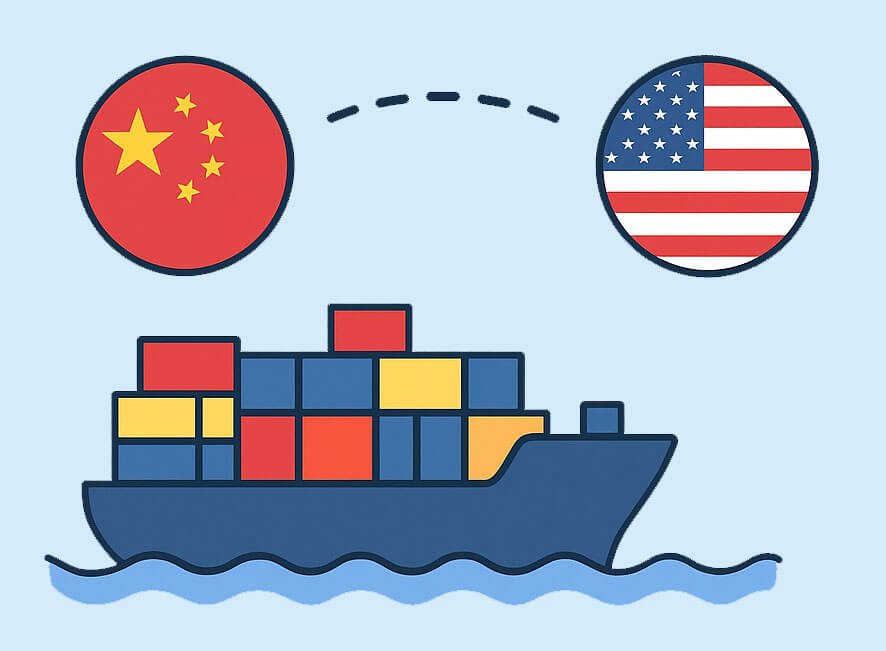

Global trade has never been more accessible — but it has also never been more complex. Many importers quickly learn that moving products from a factory in China to a warehouse in the United States involves far more than booking a container. Logistics today requires documentation accuracy, customs compliance, supply chain coordination, and cost control at every step.
This is where freight forwarders play an essential role.
A freight forwarder is not just a shipping agent. They function as your logistics planner, documentation coordinator, compliance advisor, and problem-prevention system. Without one, importers often face avoidable delays, surprise fees, and supply chain stress.
In this article, we will break down what freight forwarders actually do, why working directly with carriers is rarely enough, and how the right freight forwarder helps U.S. importers reduce risk, prevent delays, and cut costs by 20–50%.
1) Why International Shipping Is More Complicated Than It Seems
Many new importers assume shipping works like this:
“The supplier sends the goods, and the ship brings them to the U.S.”
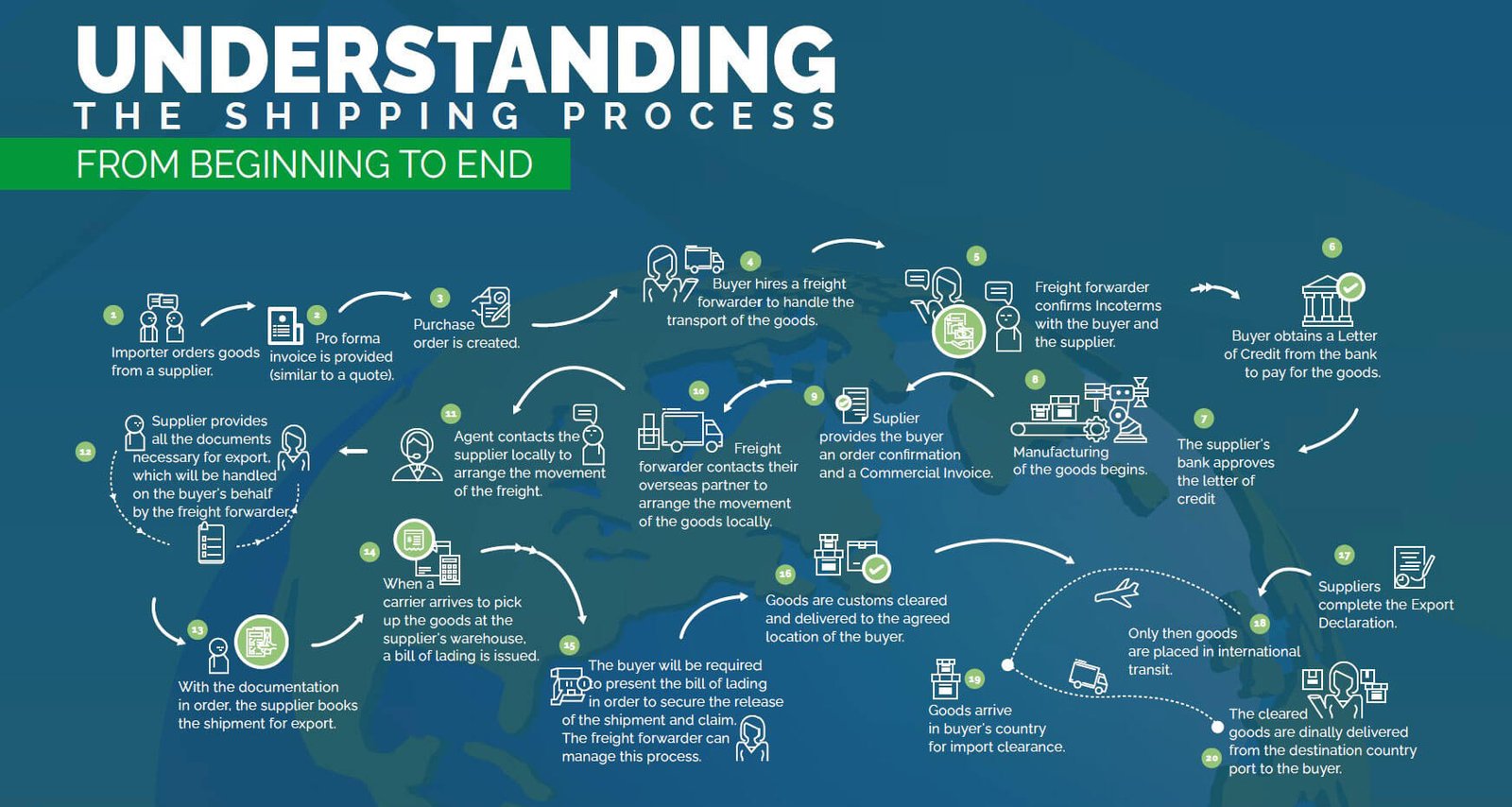
But the real journey looks more like this:
Factory pickup → Export customs → Origin warehouse → Container loading → Ocean carrier scheduling → Port arrival → U.S. customs clearance → Exam/inspection if needed → Port free time countdown → Drayage trucking → Warehouse delivery
Each stage involves different documents, deadlines, regulations, systems, and people.
If even one step is mishandled, consequences often include:
- Customs holds
- Storage charges
- Missed delivery windows
- Return-to-origin shipments
- Extra freight and handling costs
- Stress and sleepless nights for the importer
And this is why most importers do not try to manage all of this alone.
2) What Freight Forwarders Actually Do (Explained Clearly)
A freight forwarder’s primary responsibility is to coordinate and manage the entire logistics chain so the importer doesn’t have to.
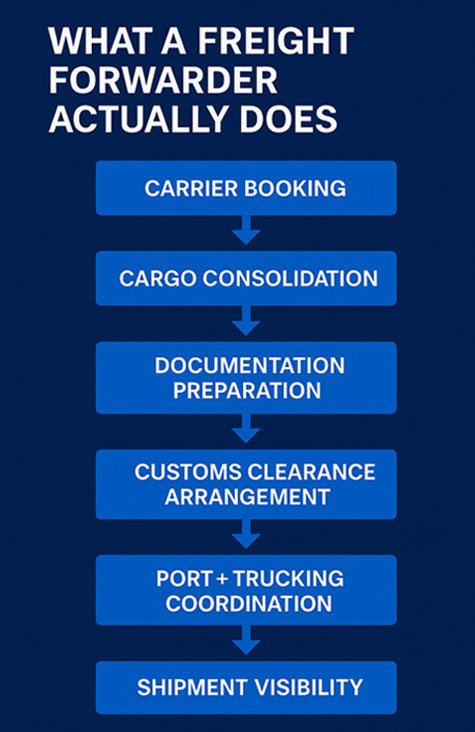
Core Functions of a Freight Forwarder:
| Responsibility | What It Means | Benefit to Importer |
|---|---|---|
| Carrier booking | Secure space on vessels at the right rate and schedule | Reliable shipping planning |
| Cargo consolidation (LCL) or FCL planning | Arrange warehouse, packing, and loading | Efficiency + lower costs |
| Documentation preparation | Commercial invoice, packing list, bill of lading, certificates | Avoid customs delays & errors |
| Customs clearance arrangement | Coordinate entry filing, HTS classification, duty calculation | Smooth clearance, fewer holds |
| Port + trucking coordination | Make sure cargo moves out before storage fees begin | Prevent demurrage/detention |
| Shipment visibility | Tracking, milestone reporting, problem resolution | Transparency + control |
In other words:
A freight forwarder turns a complex chain of moving parts into one organized, predictable process.
3) Why Booking Directly With Carriers Is Not Enough
Some importers think:
“Why not book directly with Maersk, COSCO, or ONE and skip the middleman?”
The answer is: Carriers move containers — but they do NOT manage logistics.
Carriers do not:
- Handle customs clearance
- Check your documentation for compliance
- Coordinate with your supplier on loading requirements
- Manage warehousing or trucking after the port
- Protect you from delays, exams, or storage fees
Carriers provide port-to-port transport only, not door-to-door solutions.
Even Maersk’s official logistics guide makes this distinction clear:
https://www.maersk.com/logistics-explained
If you work directly with a carrier, you (the importer) become responsible for:
- ISF filing
- Entry filing
- Scheduling pickup before port free time expires
- Managing trucking availability
- Resolving customs holds or exams
- Paying storage fees if anything runs late
Most businesses simply don’t have the internal team to manage all that.
4) The Top Risks in International Shipping — and How Freight Forwarders Prevent Them
Risk #1: Incorrect or incomplete paperwork
Incorrect commercial invoices, missing origin docs, or wrong packing list details often trigger customs exams. Exams can delay delivery by days or weeks and cost hundreds to thousands in fees.
How a forwarder helps:
They review and correct documentation before it reaches U.S. Customs.
Risk #2: Late or incorrect ISF filing
The Importer Security Filing (ISF) must be submitted before your cargo is loaded onto the vessel. Late or incorrect filings can trigger penalties and automatic holds.
How a forwarder helps:
They ensure ISF is filed correctly and on time, preventing penalties.
Risk #3: Unknown or inflated destination charges
This is especially common when using low-cost overseas forwarders.
Importers are shocked by:
- “Port handling fees”
- “Document release charges”
- “Warehouse storage fees”
- “Chassis & PierPass fees”
- “Exam processing fees”
How a forwarder helps:
They provide transparent, door-to-door total cost, not just cheap ocean freight.
Risk #4: Demurrage and Detention Fees
If cargo is not cleared and picked up quickly, storage fees accumulate daily.
The Federal Maritime Commission has published detailed guidance on billing and dispute procedures:
How a forwarder helps:
They plan clearance + trucking + delivery timing to avoid these fees entirely.
5) The Critical Difference: Freight Forwarder vs. Customs Broker
Most importers don’t realize:
Many freight forwarders are not customs brokers.
This means two different companies must coordinate your shipment:
| Function | Standard Forwarder | Your Company |
|---|---|---|
| Freight handling & scheduling | Yes | Yes |
| U.S. Customs Clearance | Outsourced | Done in-house |
When customs brokerage is separate, delays happen because:
- Documents get passed between companies
- Communication slows down
- Customs clearance starts after arrival instead of before
But because your company is a registered U.S. customs brokerage, you provide:
- Pre-clearance before arrival
- Reduced risk of exams
- Faster release at the port
- Lower total landed cost
CBP’s definition of licensed brokers
This single-provider model is your strongest competitive advantage.
6) What Shipping Looks Like With vs. Without a Freight Forwarder
Without a Forwarder
Importer must:
☐ Manage suppliers
☐ Book carrier space
☐ File ISF
☐ Handle customs entry
☐ Arrange trucking
☐ Track free time
☐ Resolve delays alone
Stress level: High
Cost risk: Very high
With a Professional Freight Forwarder
Your forwarder + broker handles:
✅ Supplier coordination
✅ Carrier booking
✅ Compliance + document review
✅ ISF & customs clearance
✅ Port + drayage + warehouse delivery
✅ Real-time shipment tracking
✅ Prevention of demurrage/detention
Stress level: Low
Cost risk: Controlled and predictable
7) How to Choose the Right Freight Forwarder
Use this quick importer checklist:
| Must-Have Capability | Why It Matters |
|---|---|
| Licensed U.S. Customs Broker | Pre-clear shipments, avoid penalties |
| Door-to-Door Pricing | Eliminates hidden destination fees |
| China-side Consolidation | Reduces handling + LCL risk |
| Real-Time Tracking Updates | Helps you plan warehouse & sales |
| Experience With Your Cargo Type | Ensures correct HS codes and documentation |
If a forwarder cannot provide these, delays and surprise fees are almost guaranteed.
8) The Bottom Line
A freight forwarder is not an extra cost.
A freight forwarder is protection against unexpected cost.
They reduce:
- Delays
- Customs risks
- Hidden fees
- Inventory disruptions
- Logistics stress
And when your freight forwarder is also a licensed U.S. customs broker, the benefits multiply:
- Pre-clearance
- Cost control
- Timely delivery
- Smooth logistics from pickup to warehouse
This is how importers save 20–50% on total landed cost, not just freight rates.
Want a Free Import Cost Review?
We can analyze your current shipping strategy and show:
- Where hidden fees are coming from
- How to prevent customs holds
- Whether FCL, LCL, or hybrid shipping will lower your cost
- How to eliminate demurrage/detention charges entirely
Reply “Yes” and I’ll create a short questionnaire so we can run your no-cost shipping efficiency review.