
If you’re planning to ship goods from China to the U.S., sooner or later you’ll need to decide whether a 20ft shipping container is the right choice for your cargo. The 20ft container is the most widely recognized container size in global logistics — it’s compact, versatile, and ideal for certain types of shipments. But it also gets misused quite often, especially when cargo is heavy or packed without attention to U.S. trucking weight limits.
In this guide, we’ll walk through:
- The exact dimensions and weight capacity of a 20ft container
- How many pallets it holds
- When a 20ft is cost-efficient — and when it’s not
- Practical loading and planning tips to avoid overweight issues and delays
Whether you’re shipping to a warehouse, distribution center, or Amazon FBA, this will help you make cost-smart shipping decisions.
1. Why 20ft Containers Are So Common
A 20ft container is the “standard unit” in global shipping — it’s the size that most port, rail, and trucking equipment is designed around. If you’ve ever seen a stack of containers at a port, the 20ft is the basic building block.
But the real reason importers choose 20ft containers is simple:
A 20ft container makes the most sense when your cargo is heavy rather than large.
A 20ft can support nearly the same maximum gross weight as a 40ft — but in less space. This makes it ideal for dense, compact goods.
On the other hand, if your cargo is lightweight but bulky (think pillows, plastic trays, baby toys, or bedding), a 40ft container is usually more cost-effective.
We’ll break that down clearly later — but first, let’s get the dimensions right.
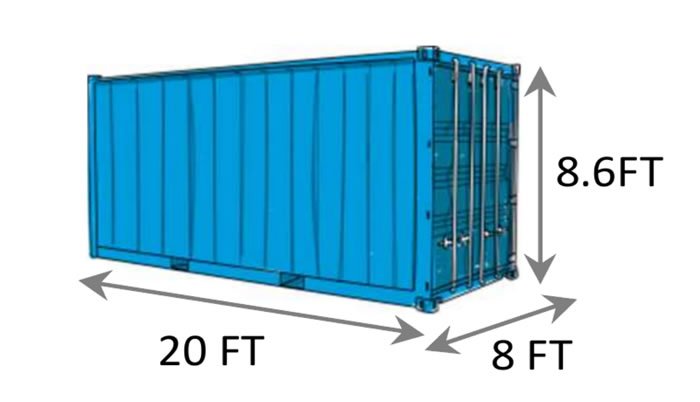
2. Standard 20ft Container Dimensions (Internal & External)
| Measurement | Metric | Imperial |
|---|---|---|
| External Length | 6.06 m | 20 ft |
| External Width | 2.44 m | 8 ft |
| External Height | 2.59 m | 8 ft 6 in |
| Internal Length | 5.9 m | 19 ft 4 in |
| Internal Width | 2.35 m | 7 ft 8 in |
| Internal Height | 2.39 m | 7 ft 10 in |
| Volume Capacity | ~33 m³ | ~1,172 ft³ |
Important:
Volume capacity matters only for large, lightweight cargo.
For most importers, weight is the limiting factor — not space.
3. How Much Weight Can a 20ft Container Carry?
This is where things get practical.
Let’s clarify container capacity vs. legal U.S. trucking limits:
| Weight Term | Approx. Weight | Explanation |
|---|---|---|
| Tare Weight (empty container) | 4,600–5,100 lbs | The container itself |
| Max Gross Weight (container + cargo) | 67,200 lbs | The absolute ISO container limit |
| Max Cargo Payload | ~61,700 lbs | In theory, the cargo limit |
But here is the real-world shipping truth:
In the U.S., most truckers can legally carry only 42,000–44,000 lbs of cargo in a 20ft container.
This is because of highway axle weight limits, not container strength.
If your cargo is heavier than 44,000 lbs, you have three options:
- Use a tri-axle chassis (extra cost, limited availability in some states)
- Apply for overweight trucking permits (cost + time)
- Split the load into two containers (often the smartest option)
We help importers make that call every day — sometimes you save by adding a second container, not by pushing weight into one.
4. How Many Pallets Fit in a 20ft Container?
It depends on the pallet type and loading method.
| Pallet Type | Pallet Size | Fit in 20ft Container | Notes |
|---|---|---|---|
| US Standard Pallet | 48” × 40” | 10 pallets | Tight load, two rows of 5 |
| Euro Pallet | 120 × 80 cm | 11 pallets | Slightly different layout |
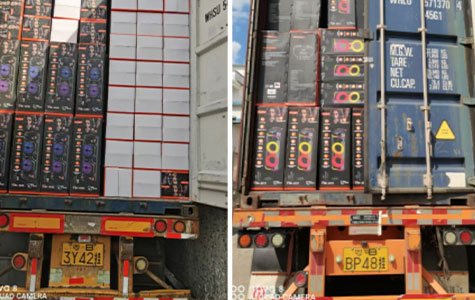
If you ship loose cartons, you’ll get more volume efficiency — but warehouse loading takes longer and requires good load securing. You need to understand Container Load Capacity & Weight Distribution
5. Best Cargo Types for a 20ft Container
A 20ft container is ideal when your products are:
- Heavy
- Compact
- Uniformly packed
Examples we commonly ship this way:
- Hardware / metal parts
- Auto parts & engines
- Ceramic tile, marble, granite
- Tooling & industrial components
- Dense electronics / power tools
- Bottled liquids (with proper packing)
If your cargo falls into these categories, a 20ft is usually the most cost-effective choice.
6. When a 40ft Container Makes More Sense
A 40ft is about double the internal volume of a 20ft — but typically costs only 20–35% more to ship.
So if your cargo is:
- Light
- Bulky
- Large volume per unit
- Or includes packaging with lots of air space…
Then 40ft gives you much better cost per cubic meter.
Simple rule of thumb:
| If your shipment is… | Choose… |
|---|---|
| Heavy and dense | 20ft |
| Lightweight or bulky | 40ft |
If you’re unsure, we can run a load density assessment on your cargo list — takes about 5 minutes.
7. How to Avoid Overweight Problems (This Saves Money)
Overweight issues are one of the most common — and most avoidable — extra costs in U.S. shipping.
Quick Preventive Checklist
✅ Know the actual weight of your cargo (not factory estimate)
✅ Add container tare weight to cargo weight
✅ Confirm U.S. trucking weight limits for your destination state
✅ If over ~44,000 lbs → plan for tri-axle chassis or split load
We routinely weigh and confirm loads before departure in China — not at arrival.
This avoids surprise trucking delays and drayage fees at the port.
8. How Much Does It Cost to Ship a 20ft Container?
The cost depends on several variables:
- Port of loading (Shenzhen vs. Ningbo vs. Qingdao…)
- Destination port (Los Angeles vs. Savannah vs. Houston…)
- Market season (peak season vs. off-peak)
- Port congestion
- Fuel surcharge (BAF), security fees, and trucking zone
So instead of quoting random numbers (which quickly go stale), it’s more useful to understand:
20ft containers are cost-effective when weight — not volume — is the limiting factor.
If your cargo is heavy → 20ft keeps handling simple.
If your cargo is light → 40ft gives better cost per unit volume.
We help importers compare both scenarios before they commit.
9. Pro Tips for Loading a 20ft Container Efficiently
These are real-world, everyday practices that prevent cargo damage and fees:
| Tip | Why It Matters |
|---|---|
| Place heavier items on the floor & toward the container front | Prevents imbalance & axle overload |
| Fill empty gaps with airbags / void fillers | Prevents shifting during ocean motion |
| Shrink-wrap pallets tightly | Protects load integrity |
| Avoid stacking beyond safe height | Prevents top compression damage |
| Always submit VGM (Verified Gross Mass) | Required for vessel loading — avoids terminal holds |
Small detail, big savings:
Communicate receiving hours and appointment requirements in advance → prevents truck wait fees.
10. Quick Decision Guide: 20ft or 40ft?
| If your cargo… | Best Choice | Why |
|---|---|---|
| Weighs under 44,000 lbs and is dense | 20ft | Most cost-efficient |
| Is light and takes up space | 40ft | Better cost per cubic meter |
| Exceeds 44,000 lbs | Split load into two containers or use tri-axle chassis | Avoids fines & delays |
| Is going to Amazon FBA in pallets | Either — depends on pallet count & warehouse rules | We can evaluate for you |
11. Final Thoughts
A 20ft container is practical, reliable, and often cost-efficient — when used correctly. The key is understanding the difference between container capacity and legal trucking capacity, and planning based on your cargo’s weight density.
We specialize in compliant China→USA FCL shipping, including:
- 20ft and 40ft container planning
- Customs brokerage compliance
- U.S. final-mile trucking
- DDP delivery when needed
So if you want, we can take a quick look at your cargo details and tell you which container size will save you more — usually in under 5 minutes.
Just send:
- Cargo list
- Weight per carton or pallet
- Destination ZIP code
You’ll get a clear recommendation — no guesswork.